Managing money during a trip requires clear planning, especially regarding turkey currency exchange for tourists. Relying completely on plastic or carrying a brick of foreign banknotes will cost you unnecessary fees. Knowing how cash, credit cards, physical bank ATMs, and local exchange offices interact will protect your budget from bad rates and hidden charges.
Cash vs. Cards: What to Use and Where
Turkey operates on a hybrid financial system. While major cities like Istanbul, Ankara, and tourism hubs along the Mediterranean are heavily digitized, cash remains king for smaller merchants, public transport, traditional markets, and tipping. Trying to pay for a 15-lira bottled water with a foreign credit card will earn you frustrated looks from shopkeepers.
Credit and debit cards are widely accepted in hotels, supermarkets, restaurants, mid-to-high-end retail stores, and museums. Visa and Mastercard dominate the market. American Express has limited acceptance, primarily at luxury hotels and international chains. Always notify your home bank before traveling to prevent security blocks on foreign transactions. Furthermore, carrying a modest amount of physical cash is essential before you even leave the airport, much like sorting out your Turkey power plugs before plugging in your electronics.
Using Local Exchange Offices (Döviz Bürosu)
For paper money, independent exchange offices—known locally as Döviz Bürosu—offer the most competitive rates for turkey currency exchange for tourists. You will find them clustered in high-traffic tourist zones, bazaars, and commercial districts. Unlike traditional banks, they rarely charge a commission fee; their profit is baked into the spread between the buying and selling rates.
Grand Bazaar in Istanbul usually offers some of the sharpest rates in the country, but standard street-level booths in neighborhoods like Kadıköy, Beşiktaş, or Sultanahmet are also reliable. Avoid airport exchange kiosks if possible; their spreads are notoriously wide, giving you far fewer Turkish Liras (TRY) for your foreign currency (USD, EUR, GBP).
- Bring clean, unblemished, and relatively new banknotes. Damaged, torn, or heavily marked foreign bills are frequently rejected or accepted at a steep discount.
- Count your cash in front of the teller before walking away. Mistakes happen, and rectifying a shortage becomes impossible once you step outside.
- Check the electronic board displaying rates before handing over your money.
Withdrawing Cash from ATMs
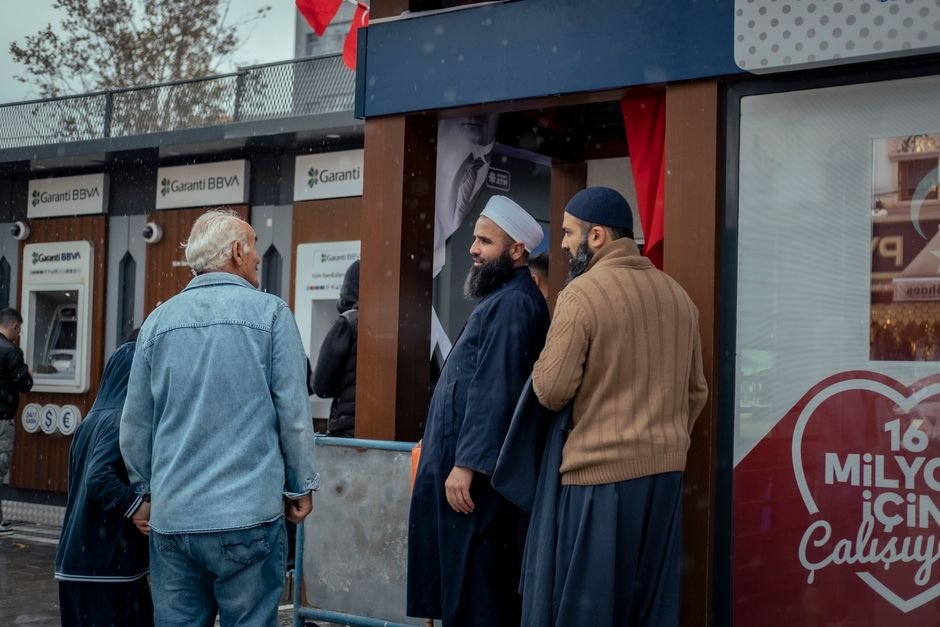
ATMs are ubiquitous across Turkey. Major banks such as Ziraat Bankası, İş Bankası, Garanti BBVA, and Akbank accept foreign cards and usually offer menus in English and other major languages. Using a local bank ATM is a safe way to get cash, but you must watch out for operator fees.
Many independent or tourist-heavy ATMs charge high out-of-network or usage fees ranging from 3% to 8%. To minimize costs, look for physical bank branches rather than standalone machines in souvenir shops or nightlife districts. Before you head out to explore historical areas, make sure you have your finances sorted alongside a solid Turkey travel insurance policy to cover unexpected emergencies.
The Trap of Dynamic Currency Conversion (DCC)
Dynamic Currency Conversion is one of the most common financial traps travelers face in Turkey. When paying by card or withdrawing money from an ATM, the terminal may ask whether you want to be billed in your home currency (USD, EUR, GBP, etc.) or in Turkish Liras (TRY).
Always choose Turkish Liras. If you select your home currency, the local bank or ATM applies its own proprietary exchange rate, which is heavily inflated and includes hidden conversion markups. Choosing the local currency leaves the conversion rate to your home bank or credit card issuer, which is almost always significantly cheaper.
Common ATM Fee Issues and How to Avoid Them
ATM errors and fee surprises can ruin an afternoon. Here is how to navigate machine quirks safely:
- Card Retention: If an ATM swallows your card due to a technical glitch, go directly inside the branch during working hours or call your bank immediately. Standalone street machines can be risky if your card gets stuck after hours.
- Surcharge Warnings: The screen will often display a fee warning before completing the transaction. If the fee is unreasonable, cancel the transaction and walk to a different bank’s machine. State-owned banks like Ziraat sometimes have lower baseline fees than boutique or international affiliates.
- Daily Limits: Remember that your home bank imposes daily foreign withdrawal limits. Plan your cash flow accordingly so you are not caught short on a weekend when banks are closed.
Navigating financial logistics in Turkey simply requires baseline awareness. Keep a mix of a reliable no-foreign-transaction-fee credit card, some physical cash obtained from an honest exchange office, and a debit card for emergency ATM runs. Avoid airport kiosks, decline dynamic currency conversion at every turn, and your travel funds will stretch much further.